March 13th, 2019
Dubsie is a singer, a socialite, a dancer, an artist in the medium of crayons, a Magna-Tile architect, a skier, a swimmer, a cyclist. What she evinces zero interest in is anything involving a ball.
Her (male) cousins are worshipful acolytes of the Ball God. Last summer, I watched her six-year-old cousin Victor play an astonishing turn at goalie, throwing himself fearlessly among sharp feet in a pickup game. An adult pickup game. Dubsie wouldn’t lunge for a soccer ball in a million years. If a scrum of children is scrapping it out for a ball, Dubsie discovers there’s a flower on the sidelines in need of picking.
Once at a festival I teed her up for a round of Skee-Ball, that game where you roll a ball up a ramp into a target in hopes of winning a stuffed animal. She took a vague glance at the carnival attraction and heaved the ball toward somewhere. The ball missed the target, the ramp, and even the booth, landing in an adjoining stall where it startled a guy selling socks. Her next two balls ended up among the socks too.
Dubsie just laughed. She cares not a whit where the ball lands. She will play a ball game if one forms around her, but the ball is only a prop in a larger plan. It goes something like this.
Victor, Dubsie and I form a triangle in the grass on a soft summer night. I lob a soft one toward Dubsie, the softest ball I can find at the slowest possible speed. It thumps against her sternum and falls to the ground.
“I have an idea!” she says, nudging the ball with her foot. “Let’s put the ball inside the hula hoop. Then I’ll stand here inside the hoop, and you two get your own hula hoops, and you stand inside them! And then we’ll…”
“Dubsie, throw the ball!” says Victor, gaze fixed on the orb.
“…then we’ll throw the ball from one hula hoop to the other. No, I’ve got a better idea. You two come to my hula hoop, and we’ll each stand on one corner, with the ball in the middle, and then we’ll all hold hands…”
“Dubsie!” I say. “Stop with the speech. There is a ball at your feet. Pick it up and throw it to Victor.”
“…sure, Dada, but first you get the ball. Or maybe a rock. Maybe we get Mummy to join us, and then there would be four people on the hula hoop, and that would be good, but maybe we could get one more person to come along, and then we’d have five. Then we could put the ball, or the rock, in the middle…”
“DUBSIE!” Victor cries in anguish.
And so it goes. Dubsie is eventually persuaded to throw the ball, or maybe not, and it goes somewhere close to its target, or it doesn’t. Either way she won’t remember a thing about it. There’s still plenty of time to teach her to throw, and I’m going to try. But I’d put more money on her being the one who makes the rules.
September 26th, 2018  Dubsie was recovering from a spot of cold and a cough, and to get out of the house we went for bubble tea. Sweet taro and tapioca balls; if only that treat had been around when I was a kid. Dubsie was recovering from a spot of cold and a cough, and to get out of the house we went for bubble tea. Sweet taro and tapioca balls; if only that treat had been around when I was a kid.
The tea shop is a new whitewashed place in the neighborhood. We agreed we would share one. The drink arrived cold and purple. I picked up a straw, one of those fat ones sized to suck up a tapioca ball, and returned to the table. But Dubsie had a word of advice.
“Dada, shouldn’t you get another straw? We shouldn’t share a straw. I’ve been sick, Dada! I don’t want to get you sick. You’ve got to go to work tomorrow!”
I shot a sidelong glance at this five-year-old grandmother of mine and obediently fetched another straw. At least somebody’s being responsible around here.
September 9th, 2018 I’m in a mind to remember of all the things we’ve given away in the last five years. The first to go, I suppose, was the Baby Bjorn bouncer, which we strapped Dubsie into back when she was still bald. Then we ditched the reusable cloth G-Diapers — what a disaster that turned out to be — that were environmentally correct but made her room reek of urine. I won’t miss those. And the little knit skullcap that a volunteer made for us at the hospital, I have no idea what happened to that.
I have goodbyes on my mind today because tomorrow is Dubsie’s first day of kindergarten. It will be a happy day, the kickoff to her formal schooling, the inception of friendships we can’t yet imagine, a powerful oar stroke across the Rubicon of girlhood. So much to celebrate, and at the same time, with Dubsie being my only child, I must take a moment to mourn.
 Photo of Dubsie by Mara Modayur A kindergartner doesn’t need the pink moccasins that we slipped on her tiny feet when she couldn’t yet walk, or the size-five tennies that she used to tuck inside my loafers by the front door, literally filling her father’s shoes. Nothing but memories remain of those. There is one pair of pink leather bootlets, with a flower sewn on the ankle, where the prospect of disposal gave us such pangs that we promised we’d bronze them (though they’re still just stashed in a drawer).
Her new school clothes include a pair of orange tennis shoes, size 13. Children’s size 13 shoes are shockingly enormous, and they loom in her closet like teenagers. We also got her a silver backpack that is dismayingly, tragically large — gear for an age we aren’t quite geared for.
Dubsie’s changing pad is long gone, of course. I no longer need to lift her tiny body by the ankles and say ‘pat pat pat!’ in a sing-song voice to entertain while I dry her rump. The species of diapers came and went, each bigger than the next until one day until she slept through the night and they became obsolete. A box of cleaning wipes remain in the bathroom, though they might dessicate before we get around to using them.
Other items, like her blue toddler spoon, linger in a drawer. We don’t need it any more, though that isn’t quite the right phrase. It’s more like I’m setting the table for dinner and need some spoons and why would I grab a different spoon for Dubsie when she can handle the normal silverware? And some time later I notice that the blue spoon hasn’t been touched in who knows how long. I hold it up and ask Do we still need this old thing? And we both contemplate it, Mummy and I, and Mummy pouts out her bottom lip and my eyes gets a little misty, and together we silently recollect the many joyful mouthfuls it conveyed to her mouth. And then, our house being a home and not a museum, we transfer it to the box for Goodwill.
Come to think of it, it’s been a while since she’s used her sippy cups. Those are next for the box. The little tube of Paw Patrol training toothpaste by her sink is nearly empty, and it won’t be replaced because it’s too flavorless for a five-year-old. And the bath toys, uh oh, they are in a dangerous state of inertia; Dubsie ignored them when she showered all by herself last week.
Mummy reached into the closet and pulled out the ingenious, collapsible booster chair that she bought years ago at a convenience store. It used to be Dubsie’s throne, parked at the dining table and flecked with dried oatmeal. Now we only haul it out on Saturday mornings when she watches cartoons. Mummy asked, Can we give this away? NO, I say, Dubsie isn’t ready. Though Mummy knows it is someone else who isn’t ready.
Dubsie’s first bicycle, which she got just last Christmas, is probably next to delete, for crying out loud. She lobbied for a bigger bike and we relented. It’s a great new ride, lavender and decked out with tassels and a kickstand. The first bike, though, is still firmly in my mental embrace, despite being so small that it makes her look like a circus monkey. She rode that bike to preschool, gliding alongside me and darting ahead. This new bike is a swifter steed. So swift that an ambling adult won’t keep pace.
Tomorrow Dubsie will take her first brave steps into a primary school classroom, and that is wonderful. But from where I stand, she will march at the head of a parade — a bobbing cavalcade of onesies and jigsaw-puzzle pieces, of stubs of crayons, of proud but dainty stretch pants, of battered shoes and chewed-on straws, marching into the past, marching into the future, and receding, receding, receding.
February 8th, 2018  The milestones for Dubsie are so tightly packed that you can’t really call them milestones; call them footstones, or inchstones. The milestones for Dubsie are so tightly packed that you can’t really call them milestones; call them footstones, or inchstones.
In the last six weeks, she has mastered her balance bike (and is now insisting on an upgrade to pedals); committed to memory significant chunks of the soundtrack to the musical Hamilton, with an astounding vocabulary for someone so young, scrappy and hungry; and skied her first bunny slope, straight downhill without a turn, her mother by her side and her fingers daintily extended like she was delivering little cups of tea. Too fast Mummy! she yelled.
But no accomplishment fascinates me like her learning to read. It’s happening right before my eyes. In the last month, and especially in the last week, she is recognizing word after word: House. Mouse. Water. Glue. Present. Elbow. Mess. Love. Piano. Spaghetti.
This morning she read her first poem, ‘Magical Eraser’ by Shel Silverstein, all the way through:
She wouldn’t believe
This pencil has
A magical eraser.
She said I was a silly moo,
She said I was a liar too,
She dared to me to prove it’s true,
And so what could I do?
I erased her!
What a damnably difficult language English is. How does a young mind ever decipher the word ‘eraser’?
To a four-year-old the letters are still barely more than a jumble of lines and swoops. Dubsie’s only been able to draw the alphabet for maybe six months now, and has remained innocent to what tricksters the vowels are. They didn’t seem too different from the rest, just a mellifluous a-e-i-o-u sprinkled among the consonant cousins. But try using them to pronounce an actual word.
I point at ‘Eraser’ in the title of the poem. What’s that word, I ask. She examines it for a long moment. The ‘r’ and the ’s’? No problem — they’re the hard consonant handrails. But this word starts with an ‘e.’ That letter can be pronounced any of six different ways. Which one should she use?
She vocalizes it like throwing spaghetti against a wall. “aaaa-a-ayrrre-e-e-e-eyssss,” she tries, and trails off. She looks at me.
eeeeeee, I cue her, pronouncing it like glee. She tries again.
e-e-e-e-erea-a-a-aze…
eeeera-a-a-ahsssuh…
eeeeraysuherrrr…
…eraser!” she says.
Phonemes snap into place like Legos. Her eyes light up. The problem is solved. A synaptic bridge has formed in an instant, and a group of six symbols have magically come to signify that pink and rubbery thing that sheds flecks when she rubs it against paper.
The other day she declared she would read a book. I couldn’t wait to see what she’d pick. I was disappointed when she returned with Alvin Ho, a book for older kids, an austere prairie of words with only the occasional drawing to make it interesting. She’ll get nowhere with this.
She plopped onto the couch and flipped through the pages. Flipped forward. Flipped back. The leaves opened to a drawing and she stared at it. Flipped some more. She examined a group of letters, her lips parted in concentration. I was such a bookworm as a child, spent hours and days lost in the pages of books, and to see my daughter absorbed in one took my breath away. She riffled the pages once more, then tossed the book onto a cushion. “Done!” she said. “I’m done, Daddy! I read a chapter and a half! I’ll read the rest later.”
Yes you will, I say to myself. Yes, you most certainly will.
August 8th, 2017 Our neighbor Jerry is a lifetime smoker. He often sits on his stoop while he burns away, and one day, while playing in the yard, Dubsie approached him with a question.
 Photo credit: iStock via Daily News Why do you cigarette?
Because I made a bad choice when I was young.
Do you like cigaretting?
No, I don’t.
Does it make you sick?
Yes, it makes me sick.
Do you get sick a lot?
Sometimes I get sick.
I’m not going to cigarette.
That’s a smart thing.
July 21st, 2017  A new expression has entered Dubsie’s facial vocabulary. She is learning to give the stinkeye, the scowl, the glower, what in Spanish they call la mirada asesina (the assassin’s stare). A new expression has entered Dubsie’s facial vocabulary. She is learning to give the stinkeye, the scowl, the glower, what in Spanish they call la mirada asesina (the assassin’s stare).
She thinks it is a weapon best deployed at close range. She climbs onto my chest in bed and stares into my eyeballs from an inch away, tilting her forehead like a charging bull and knitting her brows. “What are you doing?” I ask, trying to sound afraid in order to mask my amusement.
“You can’t see all the way. That’s what I’m doing,” she answers. She is not actually angry, or even irked; she is experimenting. The only way she knows if she is glaring correctly is if the top of her vision is bordered by her own fuzzy eyebrows.
Dubsie has a universe of expressions, from joyful to exasperated to furious, but this is the first one she is cultivating, breaking down, talking through. Once she works out the kinks it’s going to be a killer.
April 1st, 2017  Granny diapers are the look for the younger set this year. We have gotten Dubsie in the habit of sleeping in her own room, but she doesn’t stay there. At 2 or 3 a.m. I hear the door open and find that she’s standing attentively at my bedside with a white rectangle in her hand. The rectangle is a fresh diaper. The one she’s wearing has gotten full, and she’s had the forethought to stop by her dresser on the way in and bring me a new one.
I reach out sleepily and feel her pajama bottoms for wetness. “Did you pee through?” I ask.
“No,” she says.
She’s correct, the pajamas are dry. We just need to replace the diaper. I help her wiggle her pants down to her ankles then undo the diaper clasps. It rolls onto the carpet with a dull sound. This diaper is enormous, bigger even than you would expect on a three-year-old at three in the morning. There’s a reason it’s so big. Dubsie’s night urinations are so ardent, and the proportions of her posterior so large, and so tired are her parents of changing the sheets, that we gave up on the diapers meant for ordinary children and ordered a jumbo pack of Adult Smalls, the kind used in nursing homes. We call them granny diapers.
I am groggy and would be fine with Granny lying on the floor until morning, but this seems to offend Dubsie’s sensibility. She picks it up by a corner and, with her pajamas around her ankles, drags it to the bathroom, places a foot on the step can, stuffs the wet diaper inside, and takes tiny mincing steps back to me, where I help her don the fresh diaper (which, if you’ll remember, she’s retrieved by herself in the dark), and lift her into our bed, where she sighs with relief at finding her tiny white pillow between our two adult ones.
And then my daughter wraps my arm in a bear hug, and services her Daddy back to sleep.
February 16th, 2017 
 The game starts in bed on a Saturday morning with Dubsie lying face down on top of her Mummy. Dubsie waits in silent anticipation. The game starts in bed on a Saturday morning with Dubsie lying face down on top of her Mummy. Dubsie waits in silent anticipation.
“Skinny,” Mummy declares, wrapping her hands around Dubsie’s forearms.
Next she touches the neck. “Skinny,” she says with a scientist’s precision.
“Skinny,” she proclaims, grabbing the folds of Dusbie’s armpits.
“Skinny,” she repeats while assessing her feet.
One body part awaits, and Mummy’s hands hover over it. Dubsie holds her breath.
“THUNDER THIGHS!” Mummy yells, clapping her hands against Dubsie’s upper legs and shaking them like Jell-o molds. Dubsie squeals in laughter. Her laugh hasn’t changed a bit since toddlerhood.
Everything else is changing too fast — the forearms, the neck, the feet — getting longer and stronger, leaving us with the laugh and her glorious cheesecake thighs, as the rest of her leans toward girlhood.
December 21st, 2016 We didn’t bother prepping Dubsie for her first visit to Santa, because we knew it would be disappointingly brief. There would be no lap and no photo, and Santa would not get the chance to ask Dubsie what she wanted for Christmas because there would be too much crying.
We know this because last year we took Dubsie to an audience with a large, fluffy holiday creature, and this is what happened:

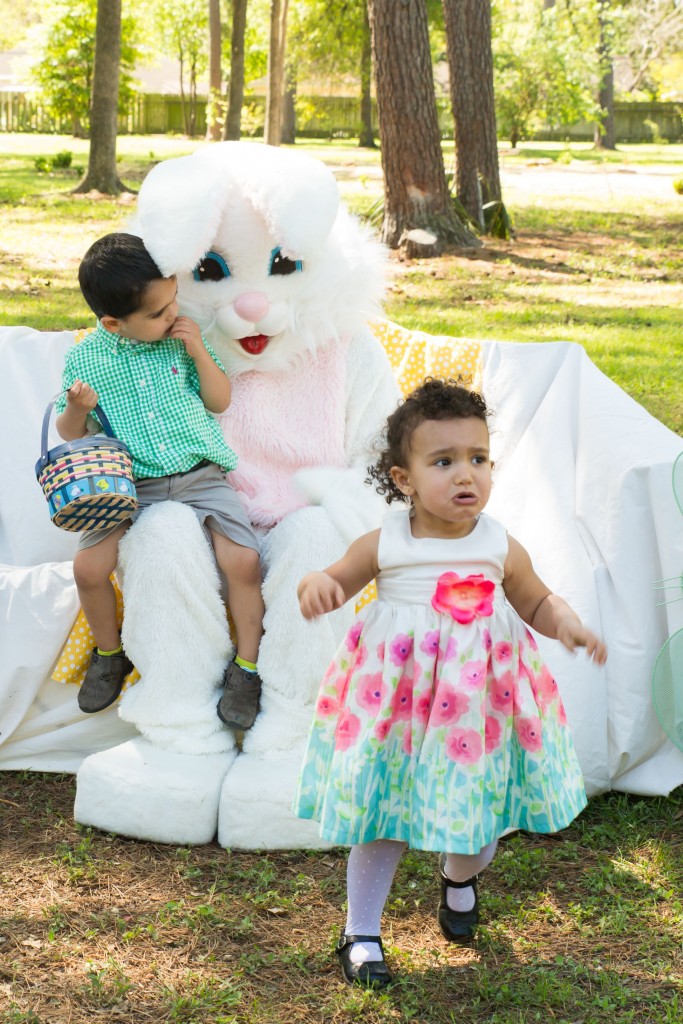
That was on a hot April day in Houston, and what could be cuter than our daughter and her cousin cuddling with the Easter Bunny after an egg hunt? Though one did have to feel sorry for the Bunny, whose lot it was to receive a line of sweaty, sugar-crazed children while dressed from head to toe in a fur suit. Dubsie did not feel sorry for him. Dubsie pointed an accusing finger at his dilated pupils and fixed grin and hollered “No… NO!” as if he were some predator whose name belonged on a registry.
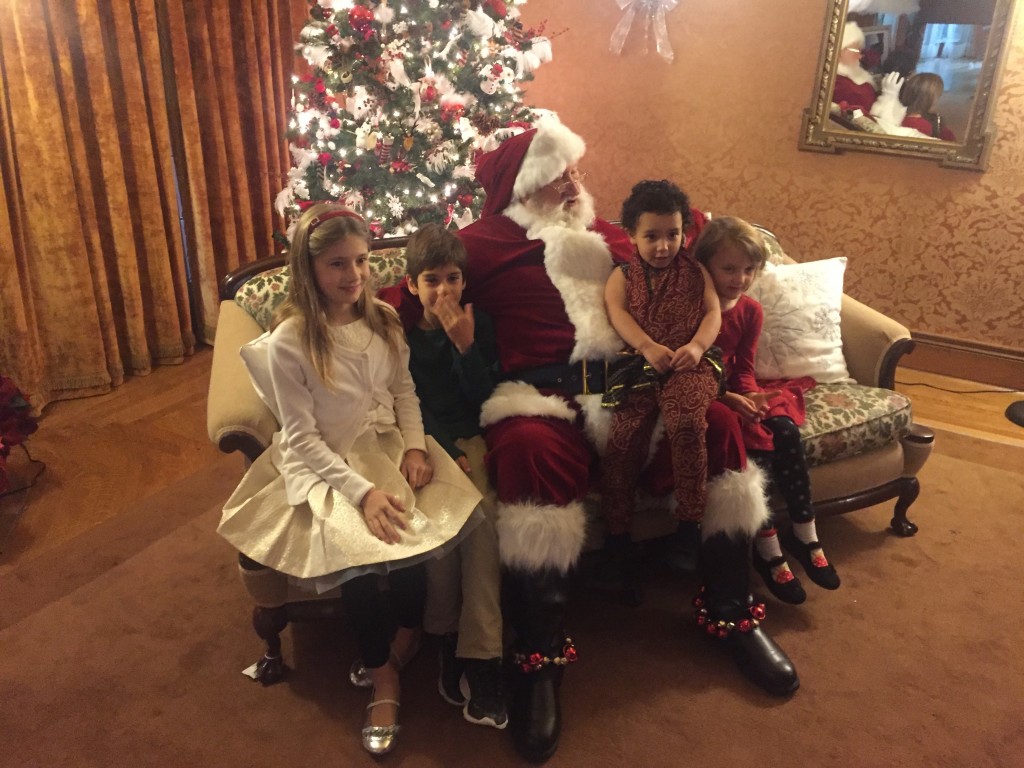
So naturally, when my sister offered us a private photo-op with Santa, we were dubious. It was a rainy late November day in Northern California, in the company of a different set of cousins. Santa was making an appearance at Ainsley House, a charming building in the English Tudor style. The trees twinkled and girl tweens in elf costumes handed out candy canes.
Santa addressed Dubsie when she walked into sight. “Well, you’re a cute little girl,” he said. “Do you want to sit on my lap?”
Dubsie walked right up and hopped on his lap.
“What would you like for Christmas?” Santa asked. Other kids had been scheming for this moment all year, but Dubsie was utterly unprepared, since her parents had assumed she harbored a distrust for cartoonish white-haired creatures.
She looked toward us expectantly for an answer, and finding none, she turned back toward Santa and couched her answer as considerately as possible. “What do you have?”

December 7th, 2016 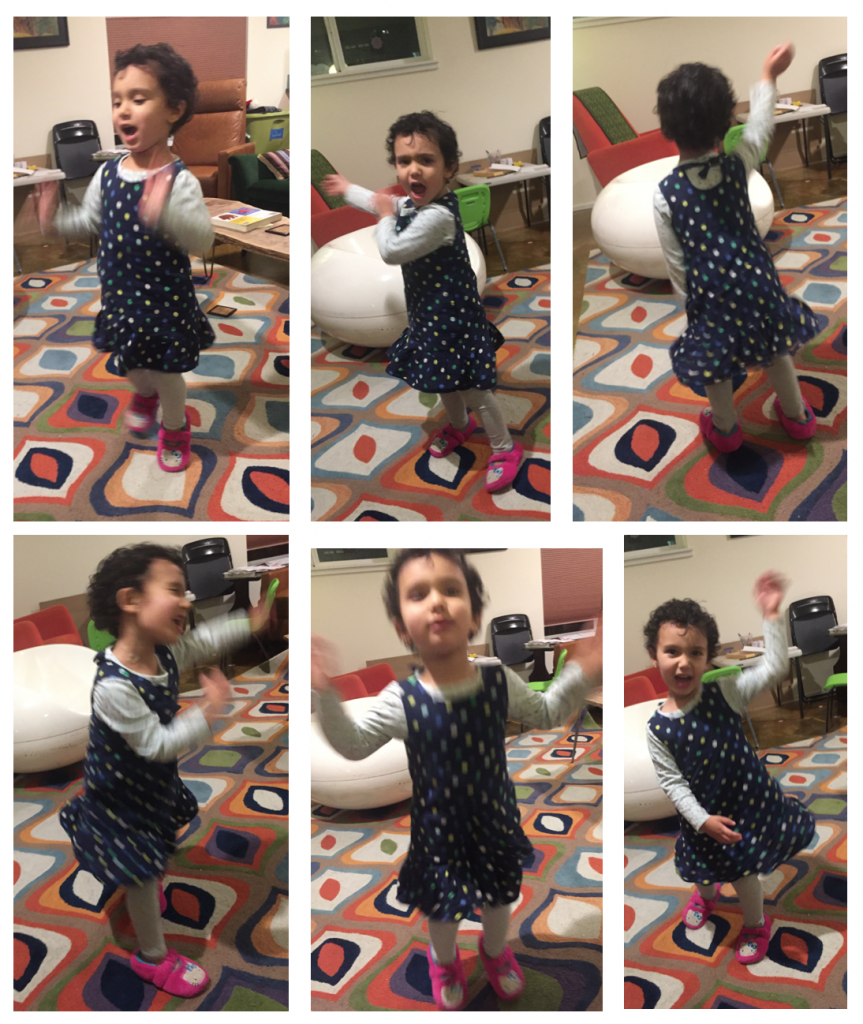 Out of nowhere, from the back seat of the car, Dubsie yells “wrecking balls inside my brain!” and when we turn to look she grins like she’s done something awesome. Out of nowhere, from the back seat of the car, Dubsie yells “wrecking balls inside my brain!” and when we turn to look she grins like she’s done something awesome.
We look at each other and mouth the question — where did she get that? — and our sweet family drive is suddenly tainted by this disoriented feeling. Guilt crossed with confusion, like your cute little three-year-old somehow slipped your grasp when you weren’t watching and smoked cigarettes in an abandoned lot with God knows who, and it’s all you fault, you horrible, horrible negligent excuse for a parent.
“Uhhhh….is that from a song?” Mummy asks carefully.
“Yes,” Dubsie replies.
Silence as the adults do some hard thinking. Dubsie’s most violent song to date had been about an itsy-bitsy spider that made some bad choices involving a water spout, and now she’s hollering about wrecking balls and brains.
“Who taught it to you?” Mummy says sternly.
“Cousin Jane,” Dubsie replies.
Ahhhh. A sigh of relief. Jane is six years old and is no vector of malice. We learned later that “wrecking balls inside my brain” is a line from ‘Fight Song,’ a pop hit that had infected Dubsie’s cousin. It was also the anthem playing when Hillary Clinton walked on to the stage at the Democratic convention to accept her nomination. (Ha ha, doesn’t that seem like a utopia now.)
It is Dubsie’s first pop song, and she’s fallen hard. We can extract just about any concession from her if the reward involves playing ‘Fight Song’ on my iPhone.
The 3 minutes 25 seconds it plays is her sacred time to dance around the living room like a crazy person and sing to herself. Try to join in, or pump your fist in the air during the drum part, and she shuts you down with a “NO, Daddy!” This is her moment, her diva requiem, the first of many pop songs she will be unable to get out of her brain, and now neither can we.
Might take a wrecking ball.
|
|




