
The solar refrigerator. The purple box at bottom is the cooler, the solar panel and activated carbon bed are on top, and the condenser is at center. Image courtesy Michigan State University.
The very idea of a solar refrigerator is a contradiction: Use the hot sun to keep things cold. How could such an oxymoron possibly work?
It would seem impossible if a team of undergraduates from Michigan State University hadn’t already built a prototype, out of cheap materials, in Guatemala.
The potential uses for a solar refrigerator are endless, from air-conditioning buildings to keeping a case of Sam Adams cold on a hot Fourth of July day. But its most immediate purpose is keeping vaccines viable for medical clinics in areas of Asia, Africa and Latin America that aren’t served by an electrical grid. The perfection of a solar fridge could significantly reduce disease in the rural developing world.
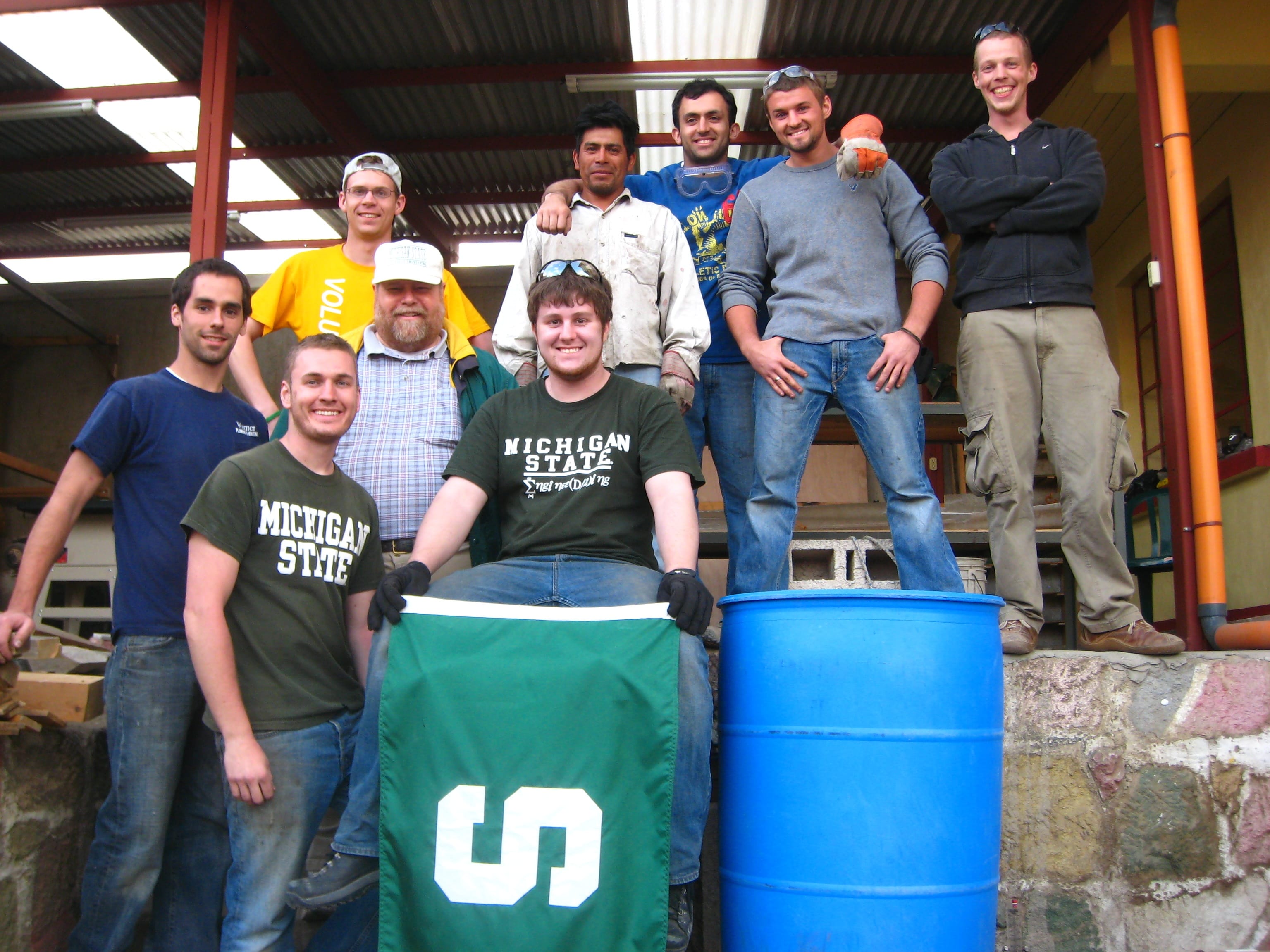
The Michigan State undergraduates who built one of the world's first solar fridges.
To get a solar fridge going, one needs a material that remains freezing cold even at room temperature. The Michigan State team chose ethanol, though methanol works too. Vacuum-sealed in pipes to low pressure, ethanol’s molecules slow and its temperature drops to about 35˚ F. The ethanol resides in the “evaporator,” a coil of copper tubes just inside the cooler. (Why is it called an “evaporator”? You’ll see in a minute).
By the end of the night, the cooler is 39˚ F, cold enough to keep its contents chilly even through a tropical day. As the ethanol has worked its cooling magic, it’s been doing something else: boiling at a furious rate. Ethanol in low pressure boils and turns into gas, just like that foggy liquid nitrogen you might have played with in science class.
Pipes direct that gaseous ethanol to the top of the box, where it drifts through a sandbox-like bed of powder at the top of the machine. The sand is activated carbon, aka charcoal. (John Barrie guesses that even charcoal from burnt coconut shells could serve this function.) The activated carbon traps the ethanol and holds it tight.

A solar refrigerator in action in Guatemala.
Then the hot sun rises. Sun rays strike the solar panel atop the machine. Directly beneath, the bed of activated carbon begins to heat up, and as it does, the ethanol vaporizes again. Only this time, the expanding gas raises the pressure in the pipes so the ethanol can turn back into liquid form. The ethanol gas fills the condenser, the matrix of pipes in the center of the drawing. The condenser has a large surface area that dissipates the sun’s heat and cools the ethanol back into liquid. As the day wears on, the ethanol trickles back down into the evaporator. By the time night falls, all the ethanol is pooled down in the evaporator, and the cycle can start again.
What if it’s cloudy? MSU professor Craig Somerton, who led the solar-fridge team, says that a fire set under the unit would keep it working.
While the sun-powered chiller is still a long way from reality, its promise is substantial. A well-calibrated solar refrigerator could go for years without maintenance, and most importantly, without ever being plugged into an electrical outlet. Click here to learn more and to find design drawings of the solar refrigerator.

David-
We can easily convert this design to use Methanol, which gives us about 10 degrees F. more cooling. We designed for 39 degrees for vaccine storage. Vaccines can’t be frozen and they can’t get too warm. With methanol the vaccine storage would use ice made in the solar refrigerator.
Sometime we should discuss our freezer for desert climates. Another unusual technology for freezing things.
Cheers,
John
do you have any design would like to build it.
did build a solar concentrator two years ago the kids loved it and I have hot water for free.
Volker
To Volker and others who would like to build your own solar refrigerator, I have a recommendation for you. Send your queries to Craig Somerton, a professor at Michigan State University who has led research in solar refrigerators. Craig furnished much of the information I’ve published about the solar refrigerator. You can reach him through his webpage, here:
http://www.egr.msu.edu/me/people/profile/somerton
Good luck!
I’ve enjoyed reading through these types of blogs. Intriguing stuff! Solar energy has constantly been a fascination with me.
Hi there!
I am a school teacher, major in Physics, I like to read about alternative energy a power saving innovations. I highly congratulates your group for the great achievement! Hopefully poor people in our country and around the world can benefit from this kind of fridge! Blessings!
Jose Rojas, Miami, FLorida
Einstein invented (well; agreed to have his name put on) a patent for an ammonia cycle refrigerator. They have been used for almost a century as a fuel-powered refrigeration source, commonly in recreational vehicles, boats, etc. They can be easily converted to solar power, and have been for years. Not a new idea, but ethanol/methanol is certainly much safer than ammonia.