 Why is it that many solar panels are the size of a hallway rug, while a typical wind turbine is the size of an office building?
There are many reasons, but one has to do with maintenance. A solar panel requires almost none: Install it and leave it alone for years. But a wind turbine is a finicky device with many moving parts, and the servicing makes a small turbine hardly worth the expense. I’ve always wondered whether we would ever learn to harvest wind on a smaller, simpler scale. Turns out we can.
The WindBelt was dreamed up by 28-year-old Bay Area inventor Shawn Frayne during a trip to Haiti as he tried to figure out how to deliver power to the energy-starved developing world. Frayne dispensed of the turbine altogether and explored a different aerodynamic phenomenon known as aeroelastic flutter. The marquee example of the principle is the so-funny-it’s-tragic collapse of the Tacoma Narrows bridge, aka “Galloping Gertie”:
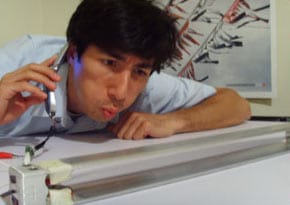
Frayne asked himself: What if I induce those same forces, but on a small scale, and use that flutter to move small magnets and produce electricity? The result is wind power on a modest, rooftop scale. This video demonstrates it best:
The company Frayne created to improve and market the technology, Humdinger Energy, is marketing three sizes of Windbelts to serve different needs. Deploy a regiment of Windbelts in a windy area, and they could supply power equivalent to a large wind turbine, but without the noise or the rotors that kill birds.

Hey man. Sending this from a Mobile. thanks! very helpful post!! like the template btw 😉
I appreciate the do the job that you’ve put in, in this page. Really great,